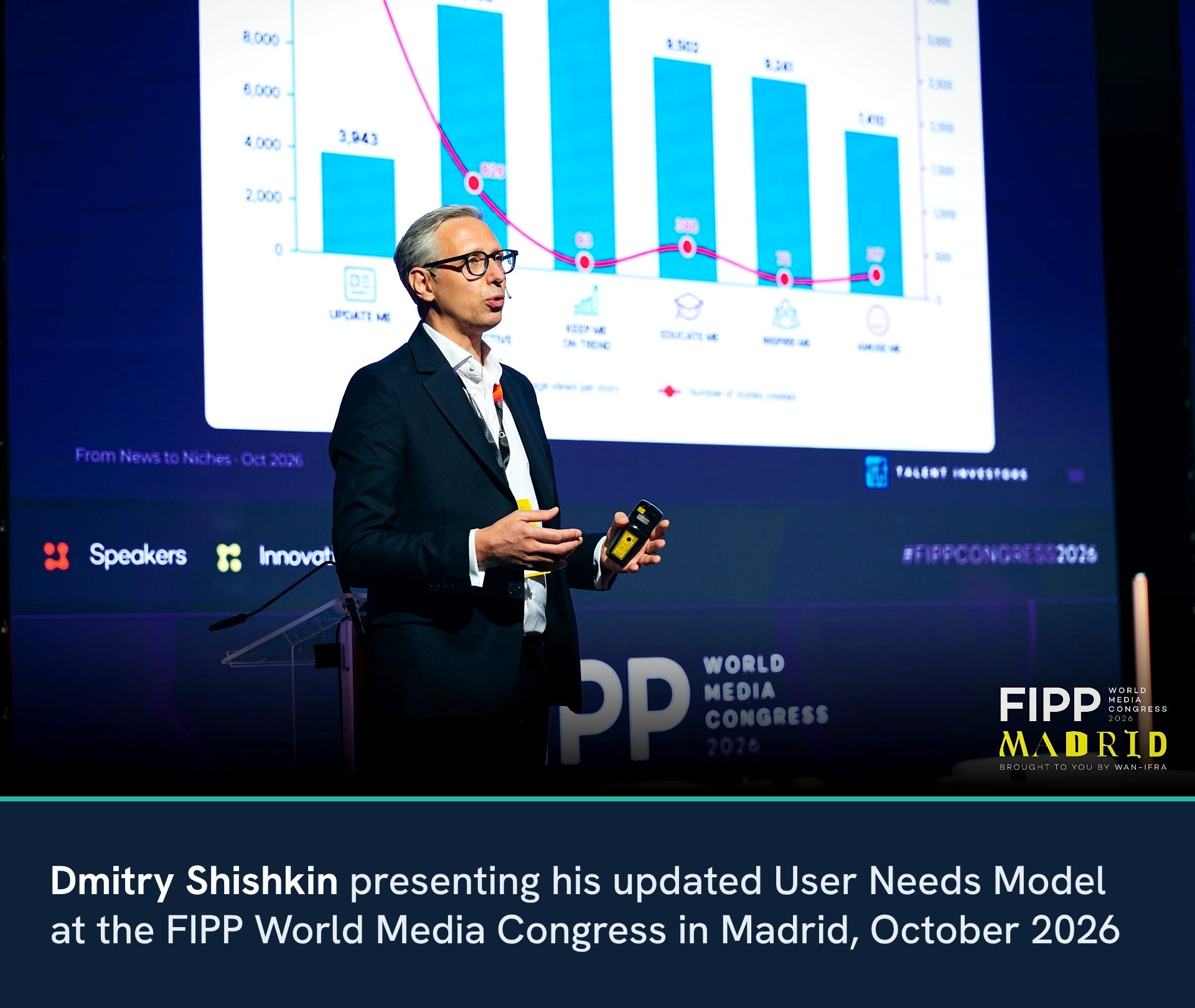
This is part two. In part one, I argued that every session needs a job, and that Dmitry Shishkin’s user needs model provides a useful framework for programming. The job comes from the user need, and a slot is defined by its subtopic, format and user need. Read Part 1 here.
Now to put it to work. The FIPP World Media Congress brings together special-interest publishers from around the world. Disclaimer: I programme the event, so I am not a neutral judge of my own programme. That is why I asked Claude’s help to analyse Day 1 of the agenda against the user needs model as an independent observer.
We ended part one with four guidelines to apply to your programming.
Frame the agenda. Start with the macro industry trends. Turn them into segment themes in the agenda. Allocate a number of slots to each theme, and list the topics that could fill them.
Give each slot a job. Decide which user need each of those slots must address. Check it within its segment, and across the whole agenda, so the grid isn’t all one or only two needs.
Build the sessions. Draft each one: a specific subtopic, a format that suits the job, and the user need.
Bring in the speakers. Research and invite the right people, then brief them on the job. Prepare with them nearer the event to go live.
Vague multi-speaker sessions almost disappear. Across the entire first day of the FIPP Congress in Madrid—spanning two main stages running in parallel from morning until late in the afternon—we booked just the one panel, focused specifically on fair publisher compensation and attribution in generative AI.
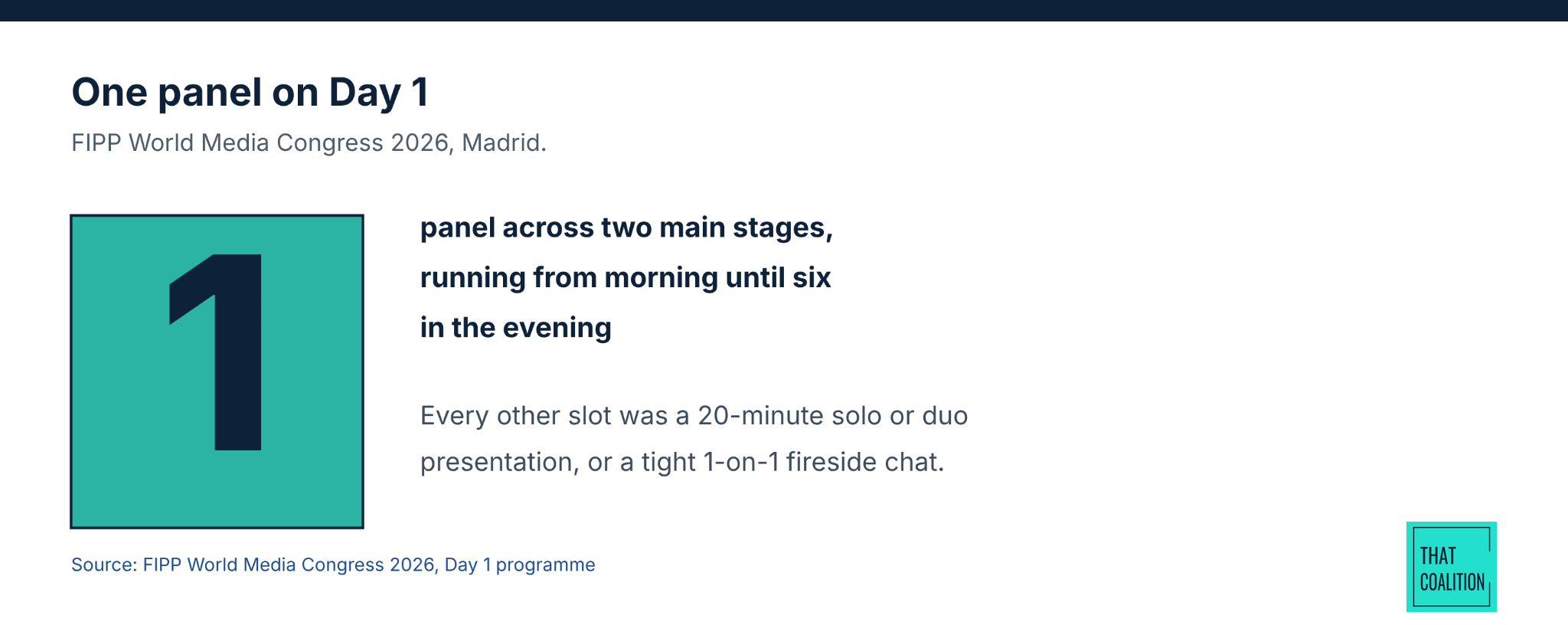
Applying the User Needs Mode to that panel, the job of the session was to give the audience perspective. It set three ways of getting paid by AI companies side by side, and it was honest about what each has earned so far. The panel and host (Jez Clifford) did this brilliantly, ensuring the multi-speaker format earned its place thanks to contrasting views.
Annelies Jansen (ProRata AI) argued for an attribution system. Kevin Anderson (WAN-IFRA) argued for managing access first, then acting together. Mark Howard’s TIME does all of it, and is now building new ad inventory for AI agents. They disagreed openly where it mattered, and brought numbers. Jez in turn pressed for straight answers and pulled the threads together at about the 34 minute mark.
There were two slips. First, two stretches drifted somewhat into product pitches. Second, the session closed on audience questions rather than a clear takeaway. I always feel it is important to involve the audience through Q&A where possible. However, in this instance a wrap would have served the session’s job better. Conversations can always continue offstage.
Other sessions on the day
Almost every other slot on the FIPP Stage (main stage) and the 101 Stage (second stage) was a twenty-minute solo or duo presentation, or a tight 1-on-1 fireside chat. We also had one 25-minute keynote, and three 5-minute partner spotlights.
Twenty minutes is a demanding timeframe (some even say not demanding enough anymore!). It leaves little room for corporate throat-clearing. It focuses the mind. If you put one executive on stage with a sharp interviewer—like having Colin Morrison question Christian van Thillo of DPG Media, or Stig Ørskov interview Jon Roberts of People Inc.—you force a single, disciplined angle from the first minute to the last.
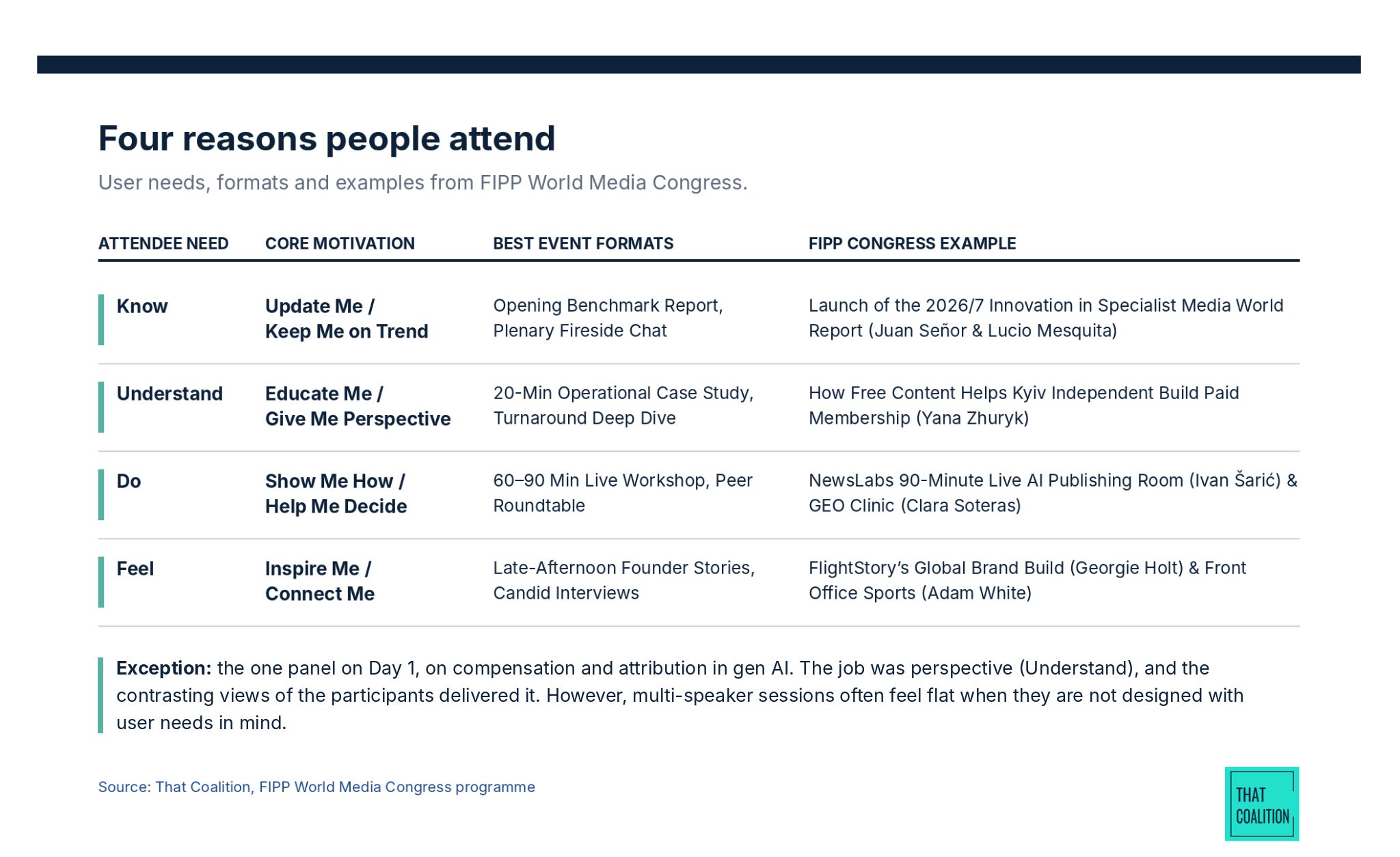
The same logic applies across a whole programme. The table image below maps the four reasons people attend (know, understand, do, feel) to the user needs behind them, the typical formats that suit each, and a session from the Congress programme (see the agenda for 14 October for comparison) as an example.
Pacing the Four Motivations Across a Live Day
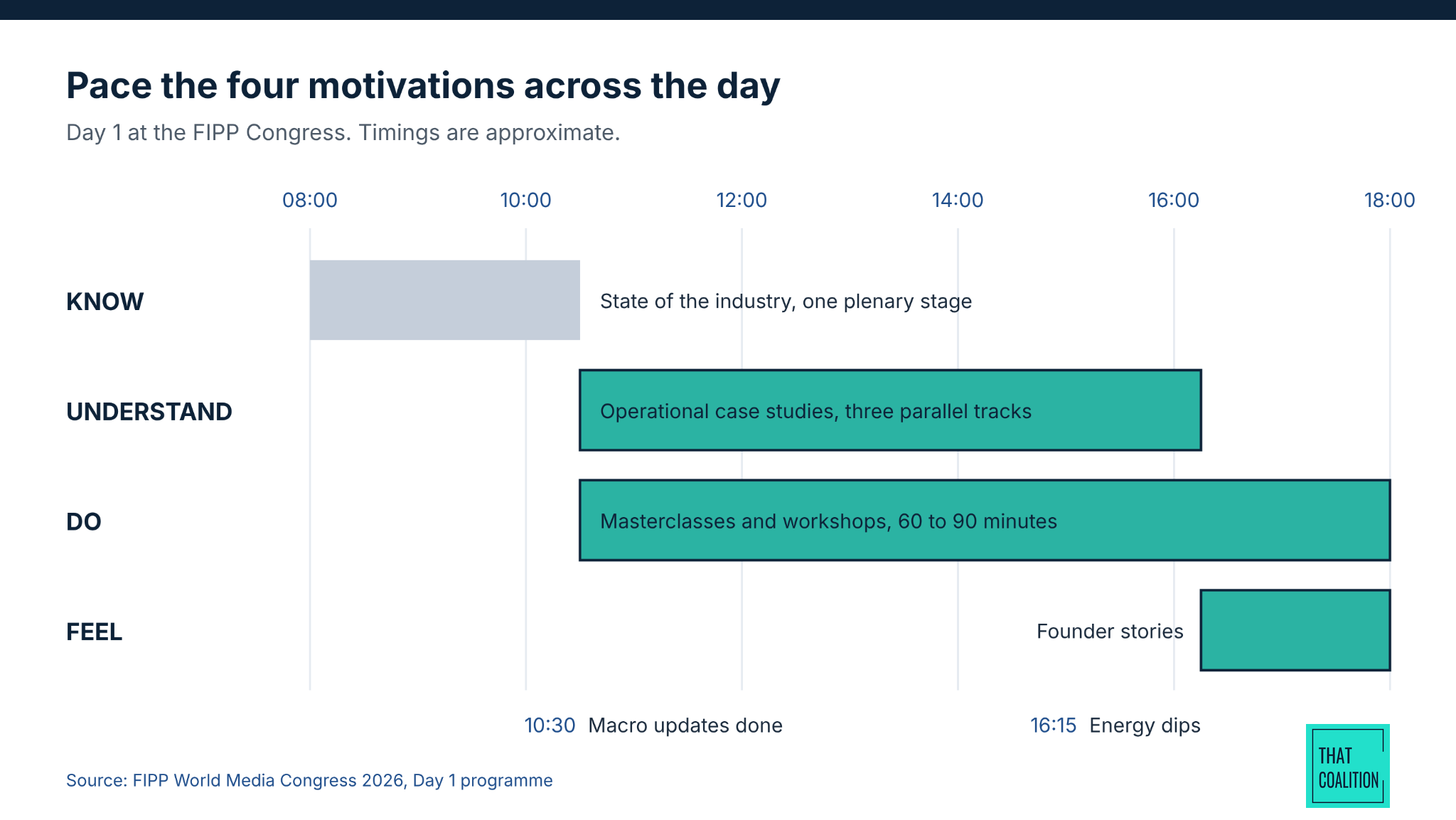
A good conference day has a natural rhythm and thought out narrative arcs that bind segments together. Audience energy rises and falls between coffee in the morning and drinks in the evening. An intent-led programme matches the user needs on stage to the psychology of the people in the room at that hour of the day.
Here is how Dmitry’s four buckets—Know, Understand, Do, and Feel—could work when you pace them deliberately across a live event.
1. Know (Update Me / Keep Me on Trend)
Delegates arriving on the first morning want the macro picture to set the scene. In Madrid, we confined it to the opening hour on a single plenary stage. One session covered how publishers get paid in the age of answer engines. Another looked at building a resilient media ecosystem through market shocks. A twenty-five minute slot launched a global innovation report.
By half past ten, everyone in the room shared the same baseline. Then the programme split into three parallel tracks, and the user needs shifted gear.
2. Understand (Educate Me / Give Me Perspective)
Mid-morning is when delegates are fresh enough to dig into how other businesses actually work. After lunch many are flagging, so you want to keep to short, concrete, story-led sessions. They must deliver operational honesty. Narrow subtopics do the heavy lifting here.
The Kyiv Independent showed how keeping its core journalism free still converts paying members. HBR showed how it serves the C-suite in depth. FIPP and UPM offered a new perspective on premium print reinvention. Later, Mansueto Ventures explained how it rebuilt the operating model behind Inc. and Fast Company, and DIE ZEIT told the inside story of its commercial turnaround.
3. Do (Show Me How / Help Me Decide)
Passive content is no longer enough to build a relationship. Dmitry’s example is Velora Cycling, a two-person publication with an interactive map of twenty years of European cycling stages that readers can filter, download and go ride. Pure utility.
Events are notoriously bad at utility. We talk at people for eight hours and call it learning.
So FIPP ran a third parallel track for Do: Masterclasses, 45 to 90-minute working sessions built around practical output.
A conversation mapping how websites must evolve for human readers and AI agents, showing participants how it works.
.A hands-on workshop on publishing with AI. Attendees brought a laptop, a story idea and clips from their own archives, and worked through four real production tasks.
A clinic on the decline of print and getting journalism to surface in ChatGPT and Google AI Overviews.
A workshop on the behavioural science of organisational buy-in, tackling the resistance that stalls newsroom transformation.
Masterclasses, workshops and round tables enable participants to leave with checklists and tools they could use as soon as they got back to work.
4. Feel (Inspire Me / Connect Me)
Now, energy tends to be low by a quarter past four. Put a dense spreadsheet presentation on the main stage then and you lose the room. That is the window for Feel: energy, human drama and a reminder of why people love their craft.
We closed Day 1 with Founder Stories: building a sports media business, why independent media is worth backing, and turning a single show into a global media brand at speed. Ending on founder ambition sends people to the reception in a positive mood, with something inspiring to talk about.
Now, I want to be clear here that I don’t think we got everything right in the agenda. A few things didn’t work as planned, and one or two I’d happily pretend never happened. The model can’t guarantee that a session works, but it does give it a much better chance.
Uniting the Event Team
There is a second major benefit to running an event on a user needs model, and it happens behind the scenes.
In his own presentation at Congress, Dmitry pointed out that user needs are the fastest way to unite an organisation. In a publishing house, editorial, product, and data teams often speak different languages.
When they agree on a shared taxonomy of audience motivations, the friction disappears. Product managers can suddenly bundle “Inspire Me” stories or “Help Me” guides from across different verticals—sports, cooking, news—and package them into new products that readers happily pay for.
How about event teams?
Event teams suffer from the exact same internal silos. Usually, the programme director wants editorial purity, the marketing team wants recognisable logos for the brochure, and the commercial team just wants to sell stage slots to hit their sponsorship target.
Making Sponsor Slots work
Sponsorship is where most conference programmes fall apart. Sales teams sell a twenty-minute speaking slot to a tech vendor. The vendor sends a sales director who delivers a twenty-minute “Update Me” commercial pitch. Attendees vote with their feet, walk out of the room, and the sponsor complains that the audience wasn’t engaged.
When you adopt a user needs framework, editorial and commercial teams finally speak the same language.
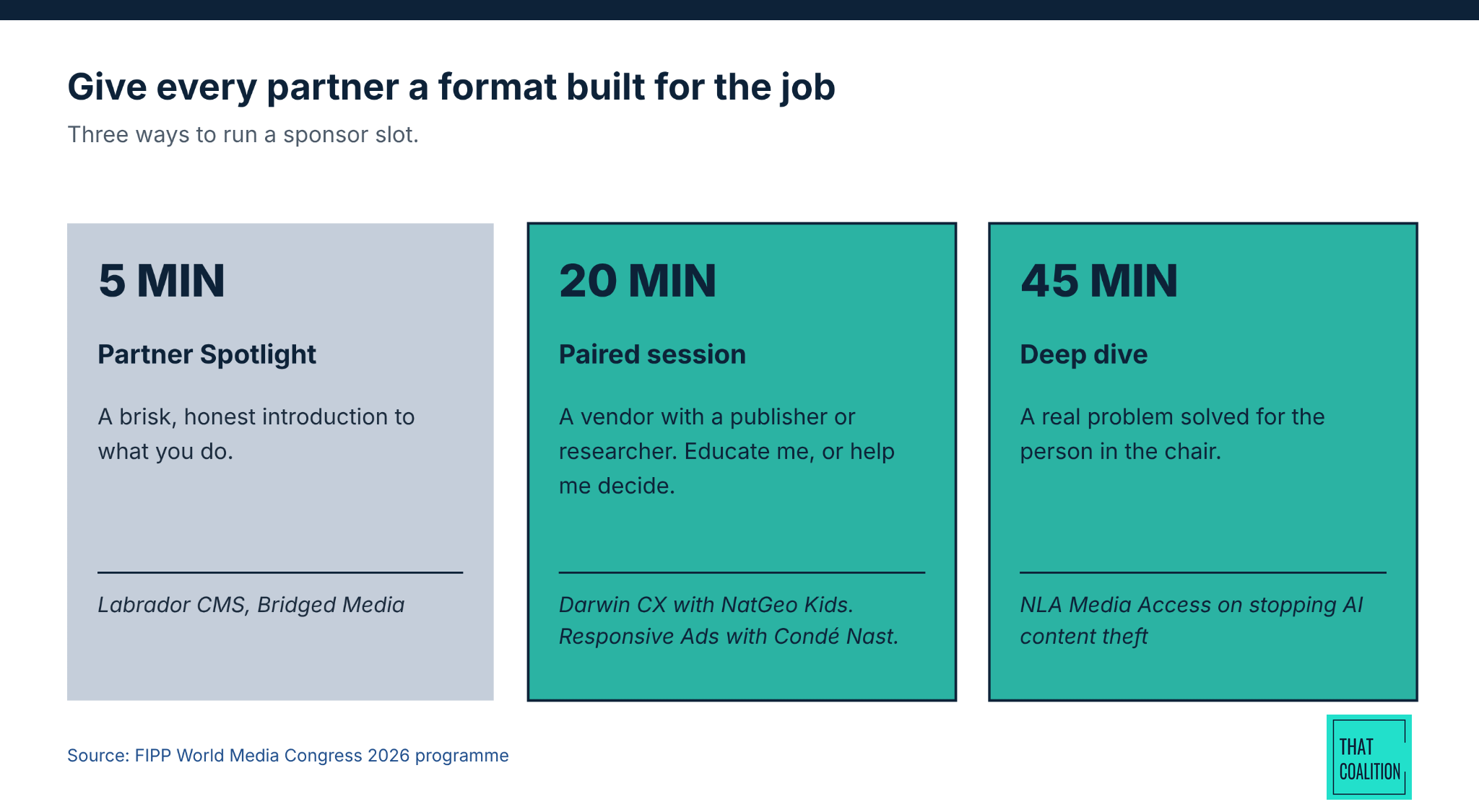
First, if a commercial partner simply wants to introduce their company and show what they do, give them a format built honestly for that job. At Congress, we have a five-minute “Partner Spotlight” for sponsors. Five minutes is brisk, transparent, keeps the room’s attention, and is plenty for the “update me” job at hand Event organisers will have variations on this theme, but the model makes it clear what job they have to do..
Second, when a sponsor buys a twenty-minute session or, for example, a sixty-minute roundtable, you must use the user needs taxonomy to steer them toward an audience motivation. This includes bringing non-vendors on board to satisfy an “Educate Me” or “Help Me Decide” need.
On the 101 Stage, Darwin CX’s Chief Product Officer Michael Smith joined Louise Ioannou, Publisher of NatGeo Kids, to talk about the courage required to disrupt direct-to-consumer strategies that are already working. Later, Responsive Ads CEO Matthew Snyder interviewed Sharon Carter from Condé Nast on how to make bespoke advertising creative scale.
The other thing to remember, is that vendors do not sit adjacent to the industry with no real contribution to make to the conversation. To the contrary. The job is to get them to do the right job for the audience, with the right people delivering that message.
What Changes If Your Event Disappears?
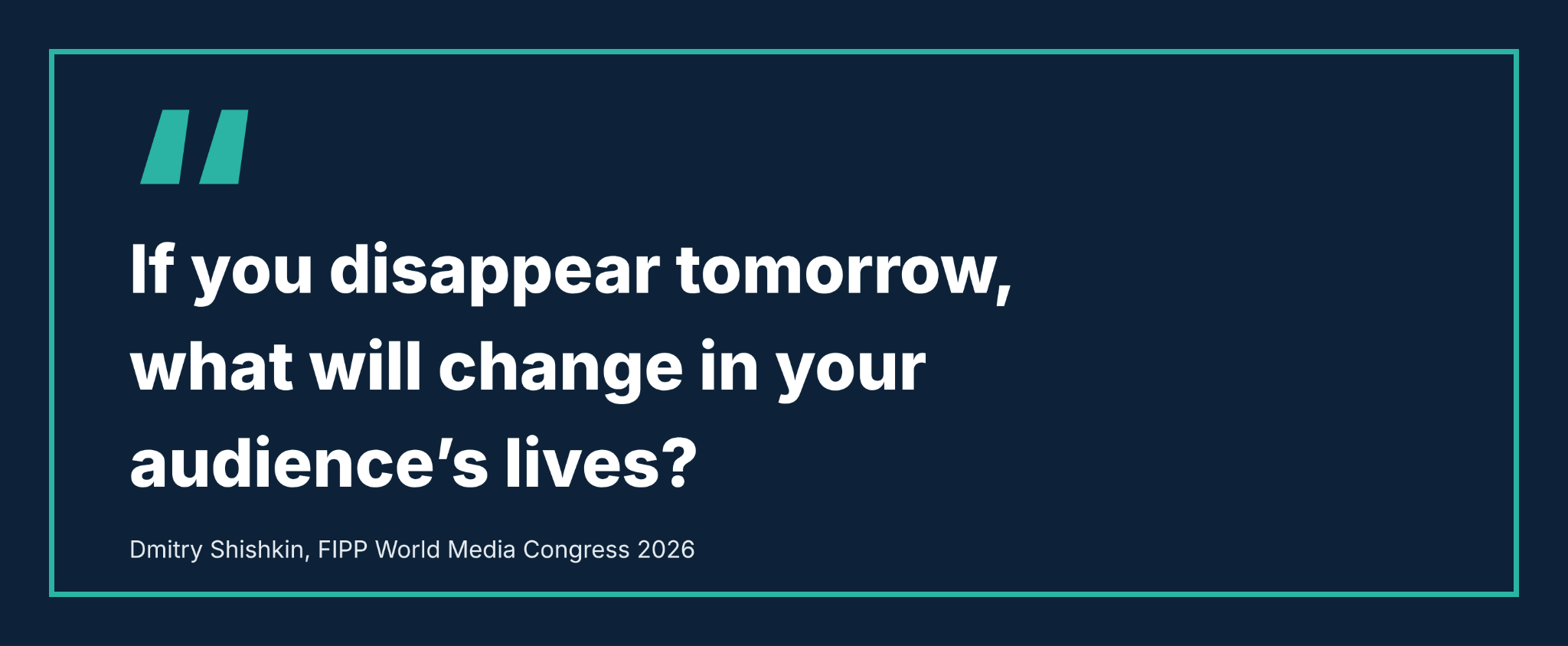
At the very end of his talk, Dmitry left the room with a blunt question for media leaders.
“If you disappear tomorrow, what will change in your audience’s lives?”
If the honest answer is “nothing”, then you are just adding to the noise. You are running a commodity factory.
Event programmers need to ask themselves the exact same question. There are so many conferences, travel budgets are tight, and nobody has time to waste listening to generic updates they could have read online (if they could even be bothered there).
If you want your event to be indispensable, stop starting with broad topics or even worse, a list of speakers that you later try to retro fit into the agenda.
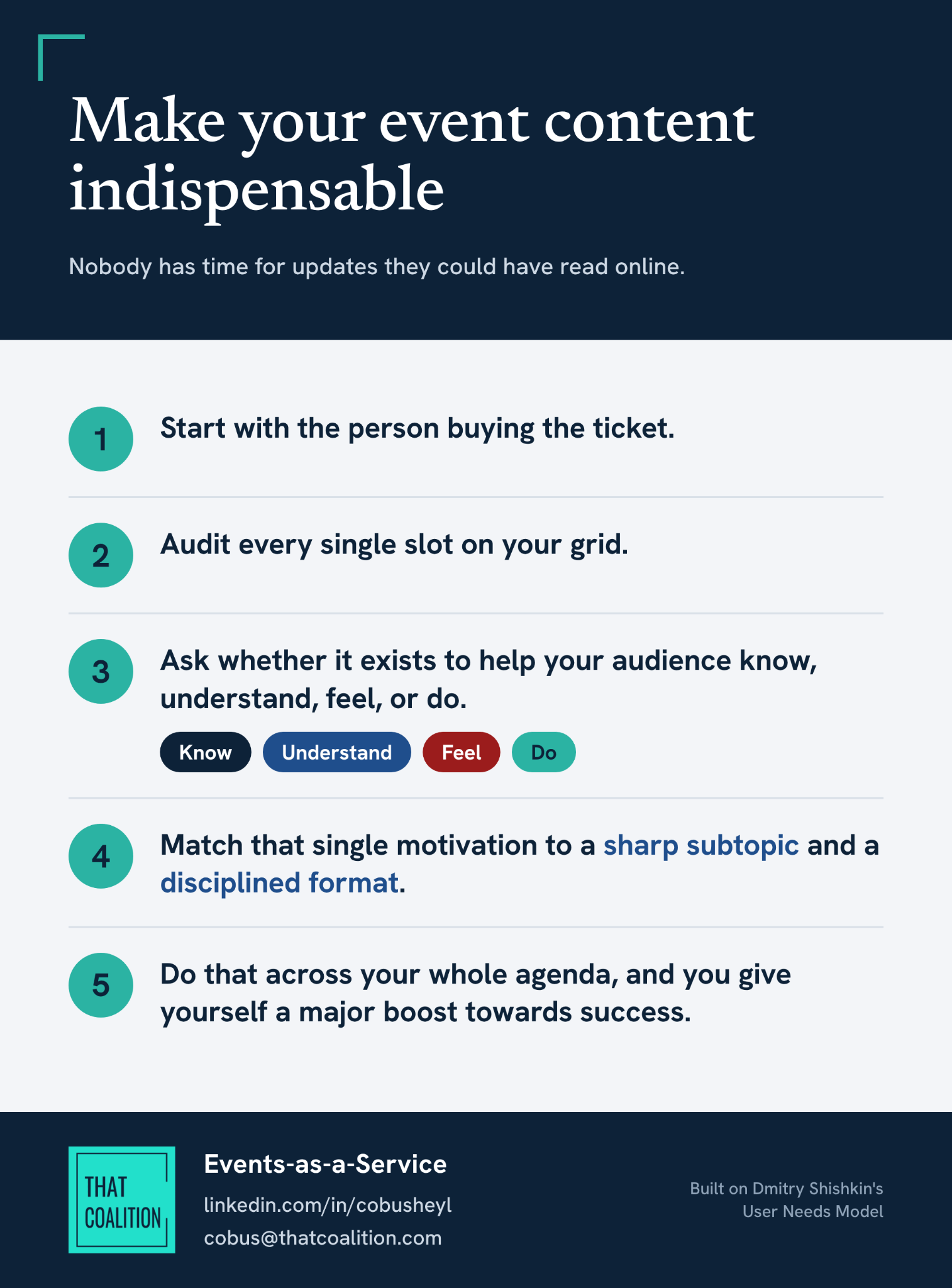
Start with the person buying the ticket.
Audit every single slot on your grid.
Ask whether it exists to help your audience know, understand, feel, or do.
Match that single motivation to a sharp subtopic and a disciplined format.
Do that across your whole agenda, and you give yourself a major boost towards success.