

Ten years ago, a chart like the one below landed on Dmitry Shishkin’s desk at the BBC. The red line showed how many stories the newsroom produced for each type of user (reader) need. The blue bars showed how many page views each type earned on average.
The two told very different stories.
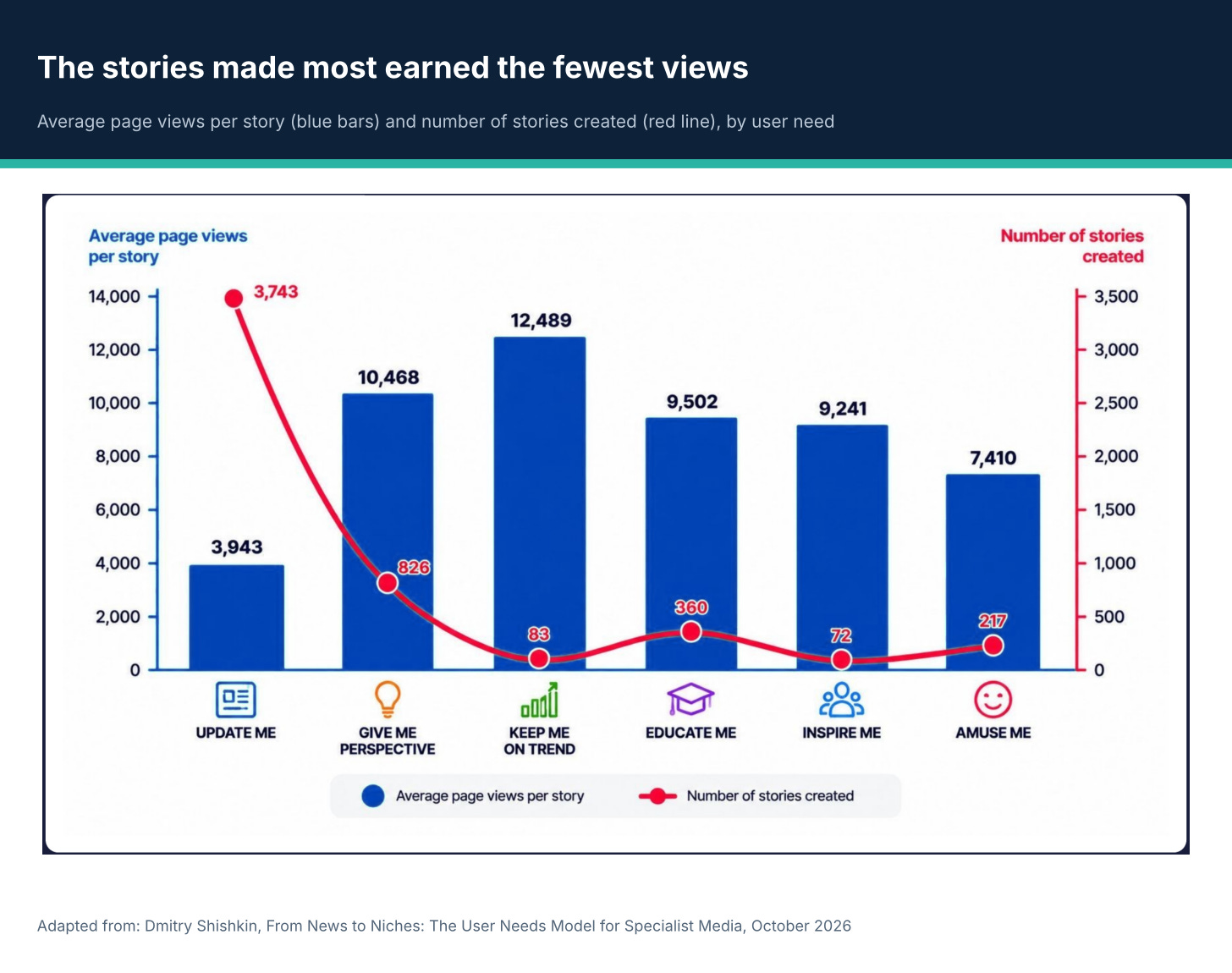
“Update Me” stories, plain reports of what happened today, were produced far more than any other type and earned the fewest views. Stories that gave readers perspective, explained, or inspired earned far more.
That kind of evidence became his User Needs Model. Since 2016 it has spread from news into sport, fashion, legal and travel publishing.
Dmitry spoke at the recent FIPP World Media Congress in Madrid (October 2026), where he explained the User Needs Model, Ten Years On.
It is a framework with a track record, and it travels well. Every need on that chart is something an audience can want from a session at an event too. And that makes it a useful frame to test an agenda against.
Below I dive into the framework, and thenI ask the objectively-minded Claude to apply it to the FIPP Congress agenda I programmed to show how it works in practice.
The Trap of “Update Me”
When Dmitry first looked at the data at the BBC a decade ago, one chart jumped out. A red line showed the sheer volume of articles the newsroom was publishing across different story angles. Blue bars showed how well each of those angles actually performed with readers.
The mismatch was glaring. The newsroom was spending the vast majority of its energy producing “Update Me” stories. These are basic reports that simply tell you what happened today. Yet on a story-by-story basis, “Update Me” articles performed the worst.
Readers were crying out for something else. When journalists wrote stories designed to “Educate Me”, “Give Me Perspective”, “Inspire Me”, or “Help Me”, audience engagement shot through the roof.
When Dmitry later took this model to Ringier Axel Springer in Central and Eastern Europe, and to the travel publisher Culture Trip as Chief Content Officer, the exact same thing happened.
Moving away from basic updates pushed up conversions, subscriptions, and reader loyalty. Since then, the framework has been adapted for fashion at Vogue, for legal publishing, and recently for sports media.
How about events?
Walk into almost any industry conference today and you will often see the exact same red-line, blue-bar problem.
Conference agendas are drowning in “Update Me” sessions. Stages are filled with executives giving broad company overviews, reading out historical milestones, or offering general state-of-the-market commentary.
This is commodity content. Everybody has it, nobody is excited to produce it, and delegates can read the same news on their phones over breakfast without buying a plane ticket.
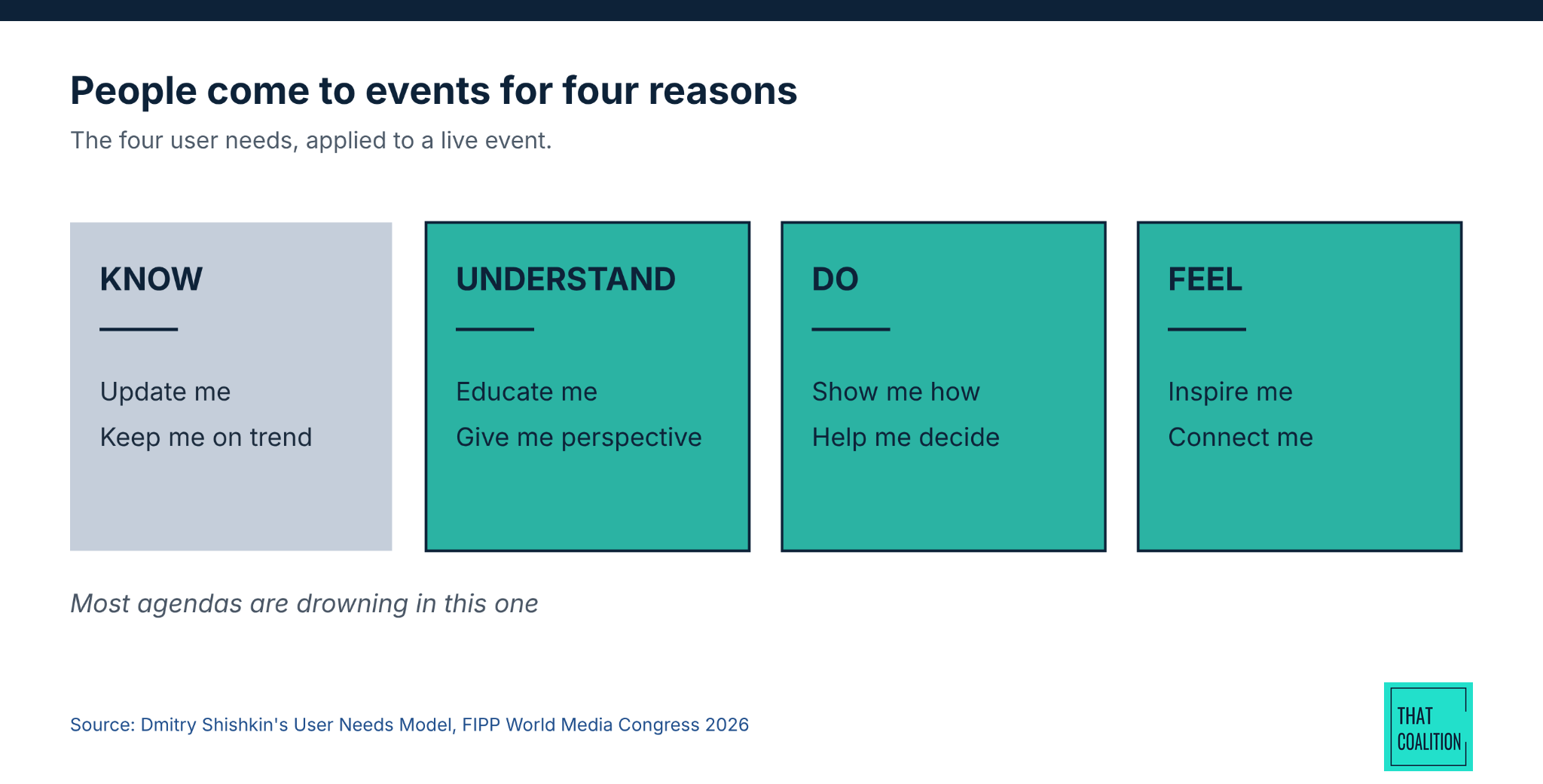
People do not travel across the world and pay a thousand pounds for a conference pass just to be updated. They come to a live event for four distinct reasons. They want to know something, understand something, feel something, and/or do something.
If your event programme does not deliberately map every slot to those four motivations, it leaves the audience experience to chance.
Frankenstein Content
In publishing, Dmitry warns editors against creating what he calls a “Frankenstein” piece of content. This happens when a writer tries to cram every possible user need into a single article. They put a bit of breaking news at the top, a chunk of historical background in the middle, an opinion quote, and a quick how-to tip at the bottom.
Writers think a Frankenstein article is clever because it has something for everyone. In reality, it fails everyone. A headline can only signal one clear promise to a reader. If the article tries to satisfy five motivations at once, four of those angles get buried and ignored.
How about events?
In the events world, it’s easy to fall into the Frankenstein trap if you program by topic alone.
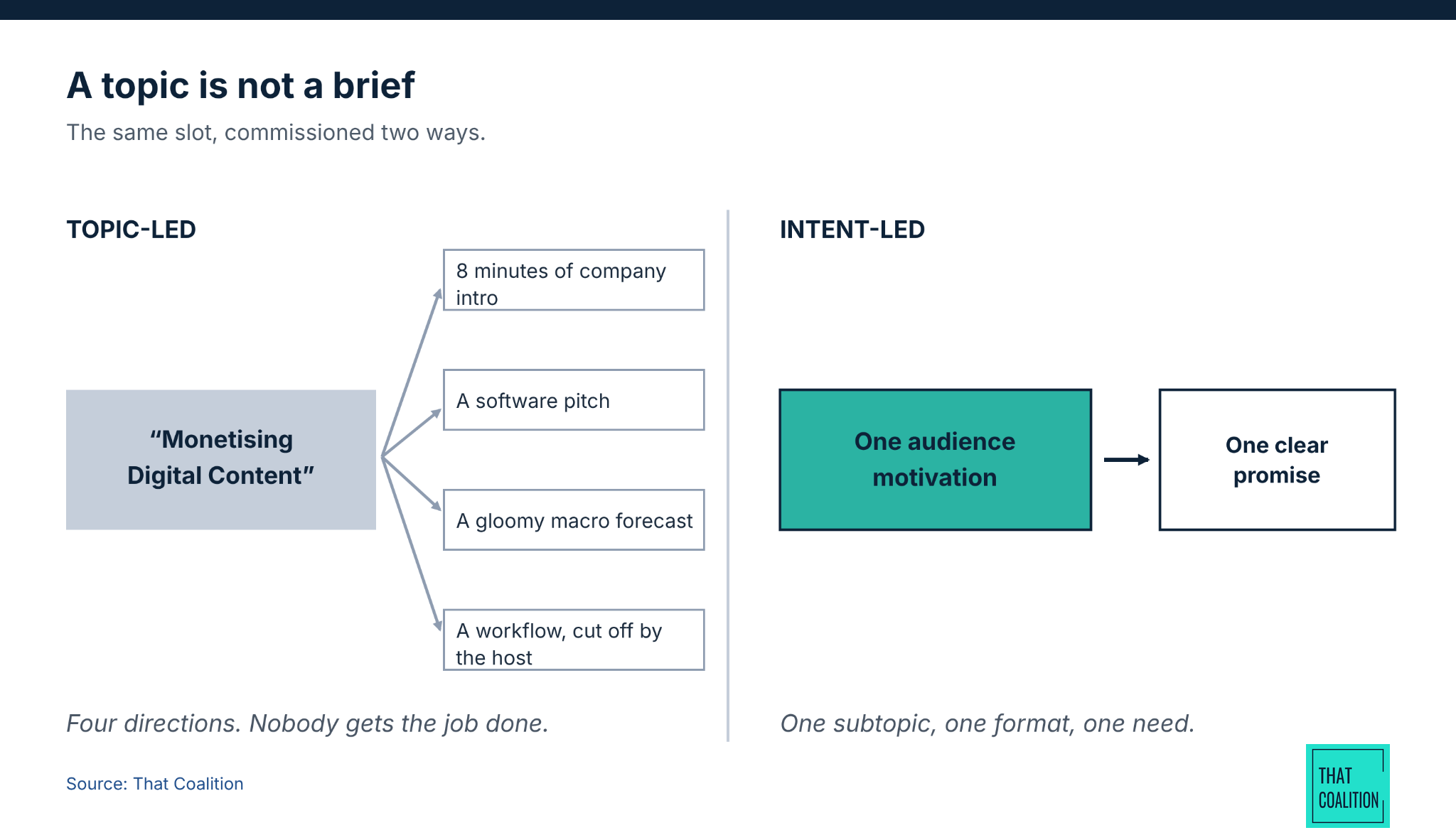
Say the agenda has a slot called “Monetising Content”. The topic is clear. The job isn’t.
Brief a speaker with only the topic and they could take it in any direction. An eight minute company introduction. A software pitch. A gloomy macro forecast. A workflow walk-through that gets cut off by the host (never over-run ;).
Each is a reasonable reading of the brief. The speaker is guessing what the audience needs. The audience is there with a specific need. Whichever way they go, the audience may not get what it came for.
Once you have your broad themes for the agenda set, decide what job each topic supporting that theme should do: update them, help them understand, show them how, or inspire them. Then build your session and find the speaker who suits the job.
So, a session on “Monetising Content” can address the following needs:
Update the audience: what has changed in how publishers earn from content this year.
Help them understand: why some revenue models work and others don’t.
Show them how: how one publisher built a paid product, step by step.
Inspire them: how one publisher made a bold bet on content and what came of it.
Choose one. Then build the session around it and make sure your speaker understands the job their session must do.
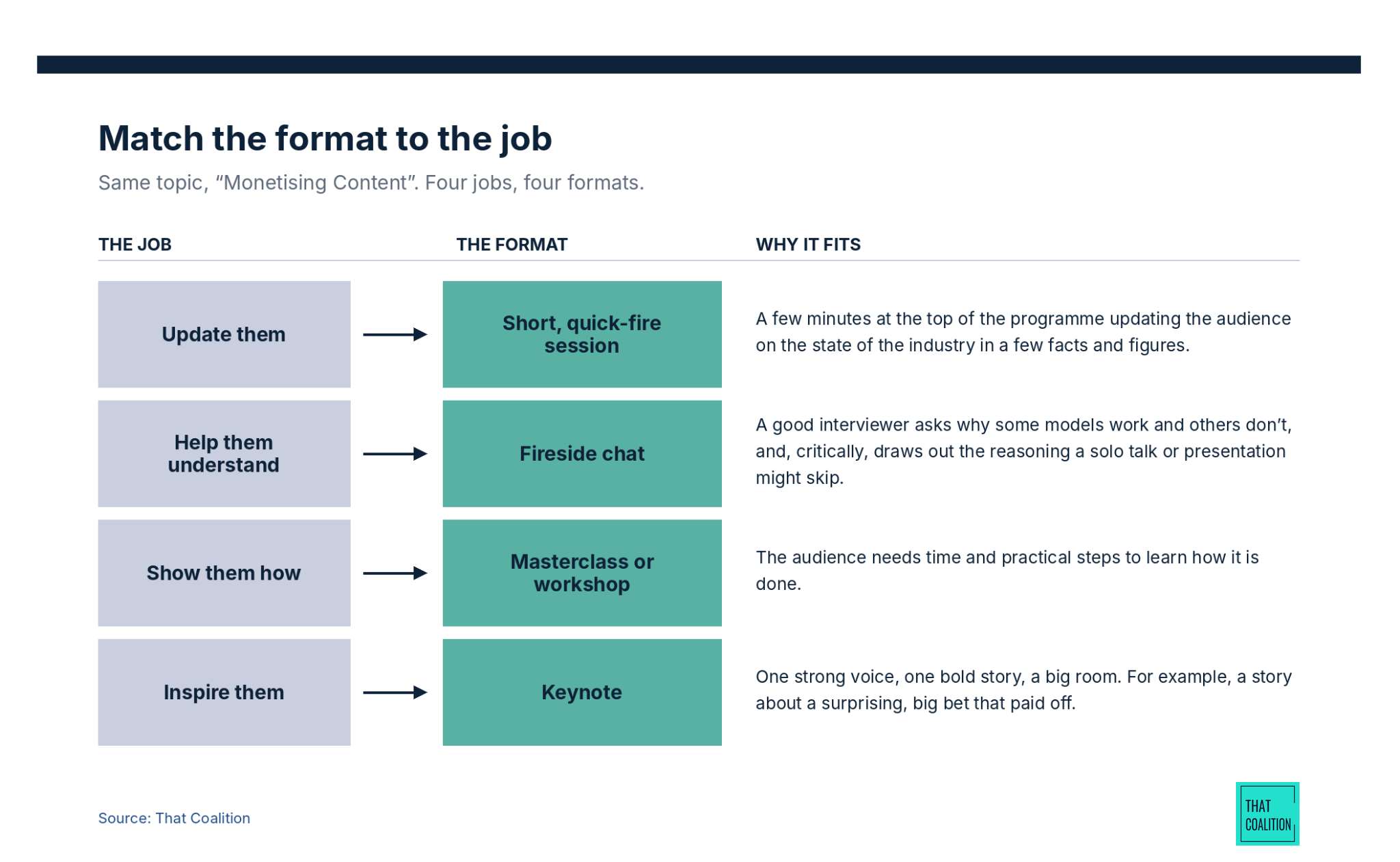
The job can also help you pick the most appropriate format for sessions. Some examples:
Update them: short, quick-fire session. A few minutes at the top of the programme updating the audience on the state of the industry in a few facts and figures.
Help them understand: fireside chat. A good interviewer asks why some models work and others don’t, and, critically, draws out the reasoning a solo talk or presentation might skip.
Show them how: masterclass or workshop. The audience needs time and practical steps to learn how it is done.
Inspire them: keynote. One strong voice, one bold story, a big room. For example, a story about a surprising, big bet that paid off.
The Three Pillars of an Intent-Led Agenda
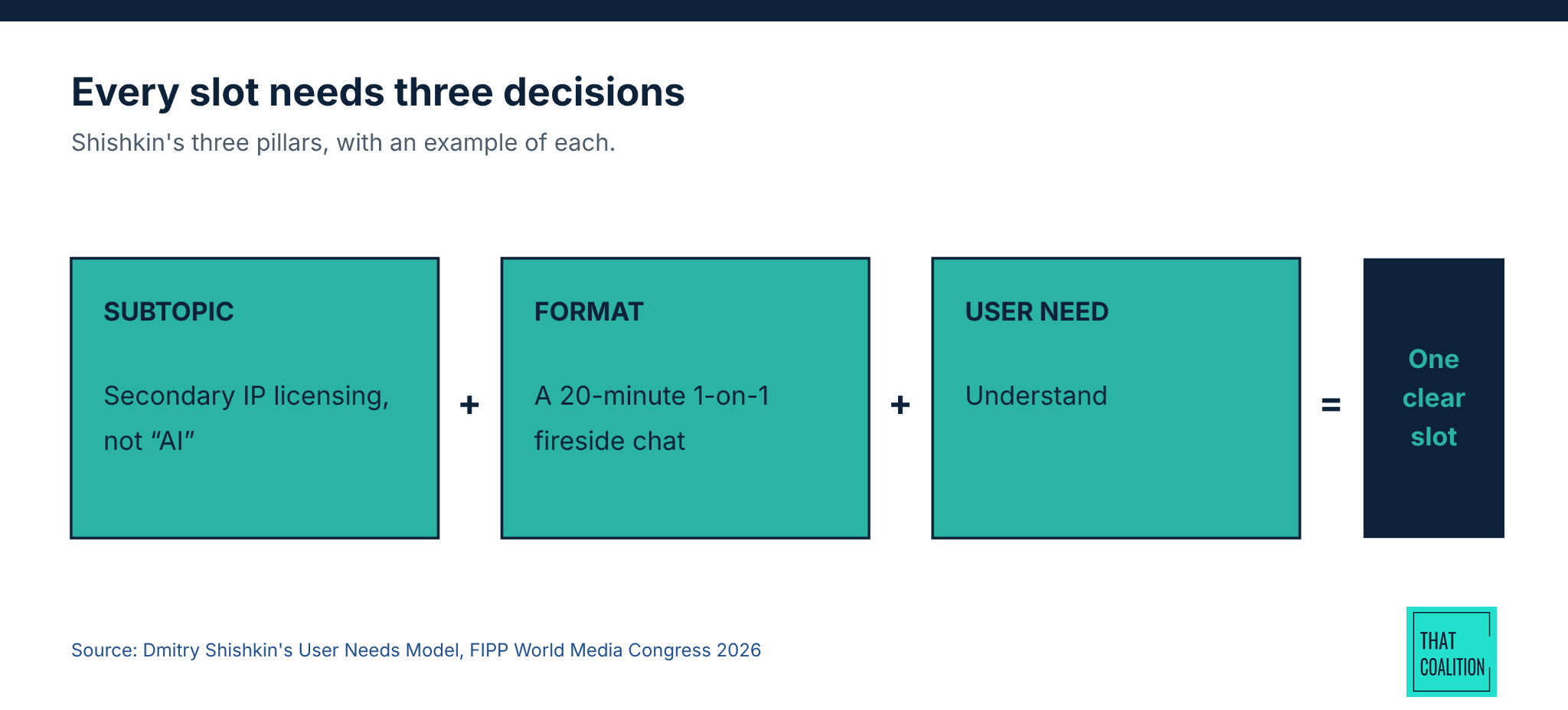
Dmitry argues that every piece of content needs a strict three-part taxonomy. If you want to build an intent-led event programme, you can apply his exact three pillars to every slot on your grid:
The Subtopic: Never commission a broad category. “Finance” or “AI” or “Advertising” is not a session. Is it secondary IP licensing or newsroom transcription workflows? Is it brand partnerships or free-to-paid membership funnels?
The Format: In publishing, audio, video, and text are not formats; they are just delivery channels. Formats are the structural mechanics: a Q&A, a listicle, a data report, or a feature. At an event, a stage is just a room. Your formats are the rules of engagement: a 1-on-1 fireside chat, a solo case study, a hands-on workshop, a peer roundtable, or a five-minute pitch.
The User Need: The single motivation that dominates the slot. Does this session exist to update the room, to give strategic perspective, to inspire them, or to teach them how to do a specific job? All the things we discussed earlier.
End of part one
Here is how it can fit together.
Frame the agenda. Start with the macro industry trends. Turn them into segment themes in the agenda. Allocate a number of slots to each theme, and list the topics that could fill them.
Give each slot a job. Decide which user need each of those slots must address. Check it within its segment, and across the whole agenda, so the grid isn’t all one or only two needs.
Build the sessions. Draft each one: a specific subtopic, a format that suits the job, and the user need.
Bring in the speakers. Research and invite the right people, then brief them on the job. Prepare with them nearer the event to go live.
In part two of this article, I will test this against a real agenda (The FIPP World Media Congress in Madrid) to showcase how it works in practice.