

Most event content is made for the people in the room. They are also the people who need it least. They were there.
While reviewing our Future of Events survey (Q1 2026) this week, planning for 2027, some data in that survey caught my eye again. One of which points to the wider audience for event content, and is worth remembering.
The colleague who couldn’t travel.
The delegate who was there, but missed the session in the other hall.
The sponsor’s boss who wants proof.
The attendee who went home and still wants to discuss shared experiences with the people they met.
The survey shows:
They want the content to reach them in their own language, in a format that suits them, after the event has ended, and in a place where the conversation can carry on.
Think of it as content that travels. The survey indicates four things that decide whether it does: language, format, time and community. I’ll add a fifth: Plannning.
Language
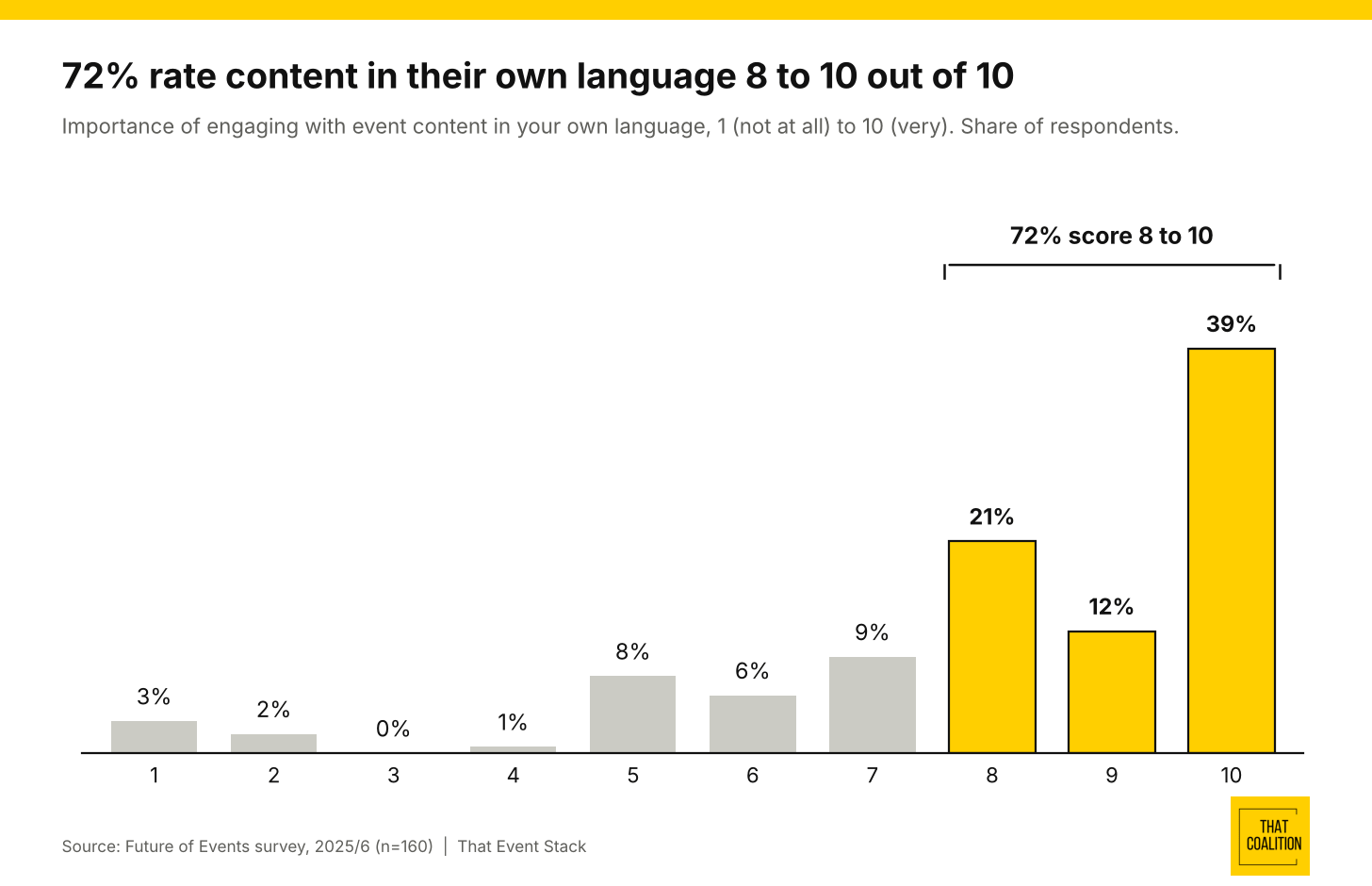
72% of respondents rate engaging with content in their own language at least 8 to 10 out of 10 for importance. 39% give it a full 10.
I expected a lower score. They answered an English-language survey, and many work in English every day. They still want more.
Outside events the picture is similar. A 2020 study of 8,709 consumers in 29 countries by CSA Research called Can’t Read Won’t Buy found that 76% prefer to buy products with information in their own language, and 40% will never buy from websites in other languages.
Most event content is created in one language, usually English, and stays there. A senior buyer in Oslo or Kuala Lumpur can follow the keynote. Can they send it to their team, or quote it in a board paper?
Format
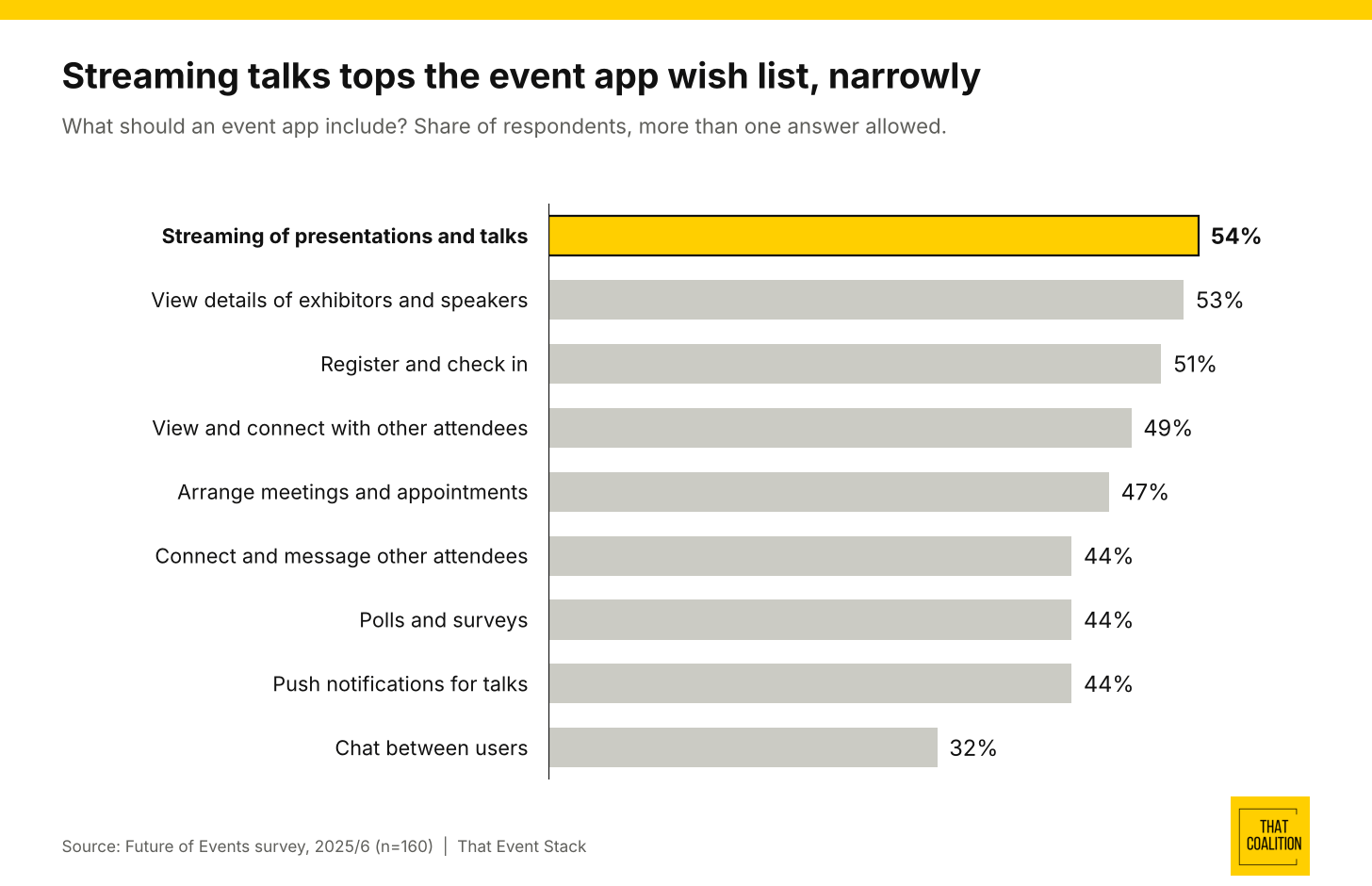
Streaming of talks is the feature respondents most want in an event app, at 54%. It edges out exhibitor and speaker details (53%) and check-in (51%). Social media engagement also scores higher than the app itself, 4.10 out of 5 against 3.94 (in these measurements, 0 is not important and 5 is very important).
Both point the same way. Attendees expect content to leave the room.
Video is one route, although few people will watch through multiple minutes-long recordings start to finish. A written summary, a handful of attributed quotes or a cross-session report may suit the many who won’t.
The same applies beyond the main stage. Workshops and roundtables score 3.98 out of 5, against 4.17 for speaker sessions. Attendees value both, so where it’s possible, the content from both these formats should travel.
Time
An event doesn’t start at registration or end with the closing keynote. But attendees want different things on each side.
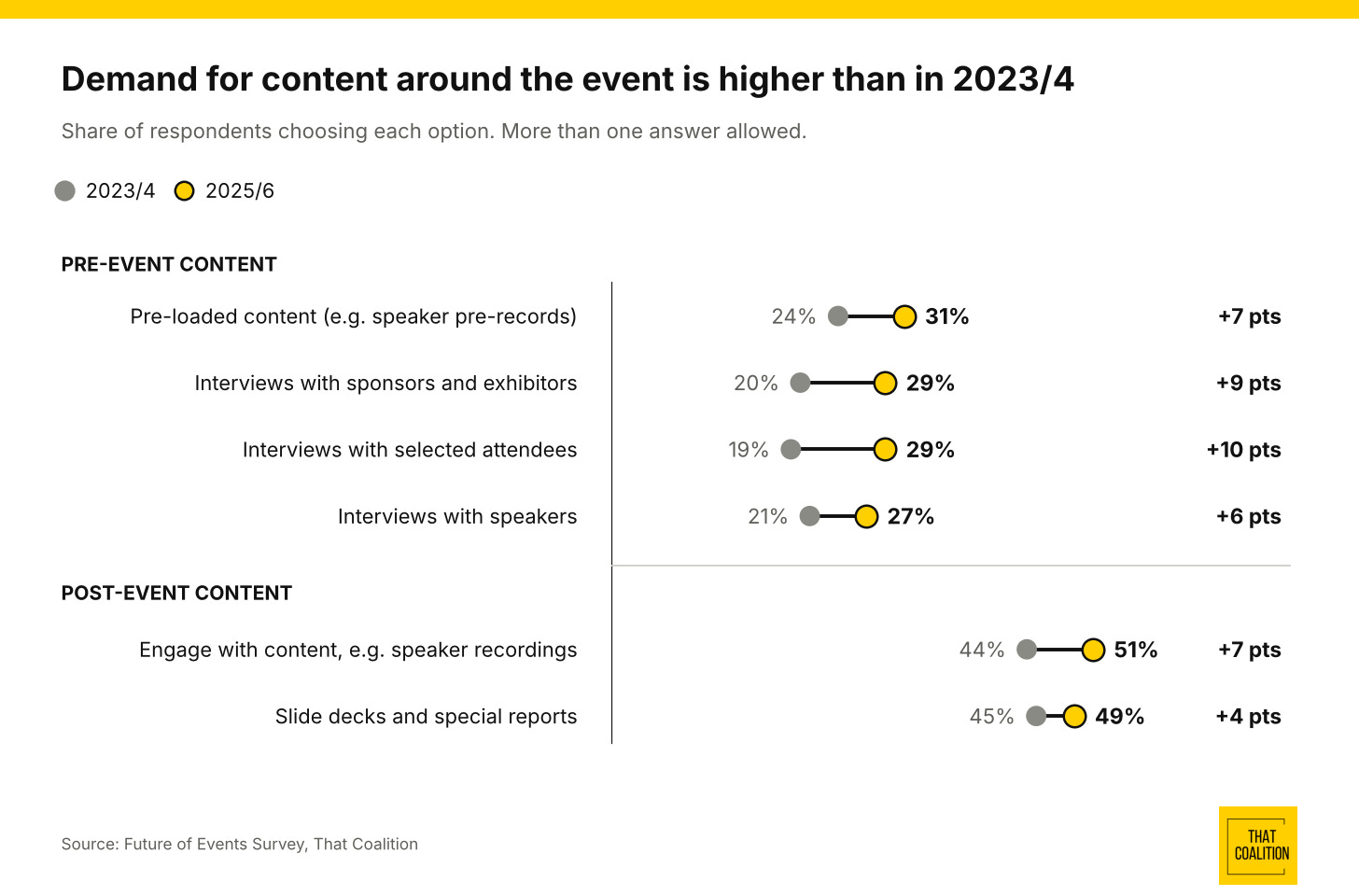
Before the event, they want information first. 51% want details on speakers and the agenda, and 47% want details on sponsors and exhibitors. Demand for other pre-event content, such as recordings and interviews, has also risen since the first Future of Events survey in 2024. It sits among the strongest of the nine options on the list.
After the event, the pull is even stronger. 51% want to engage with content such as speaker recordings, and 49% want slide decks and special reports, from a list of five. Interest here also rose steadily since the first survey in 2024.
Speed matters here. A summary sent in the week after the event reaches people while they still remember the session. Three months later it is just another email.
Community needs something to talk about
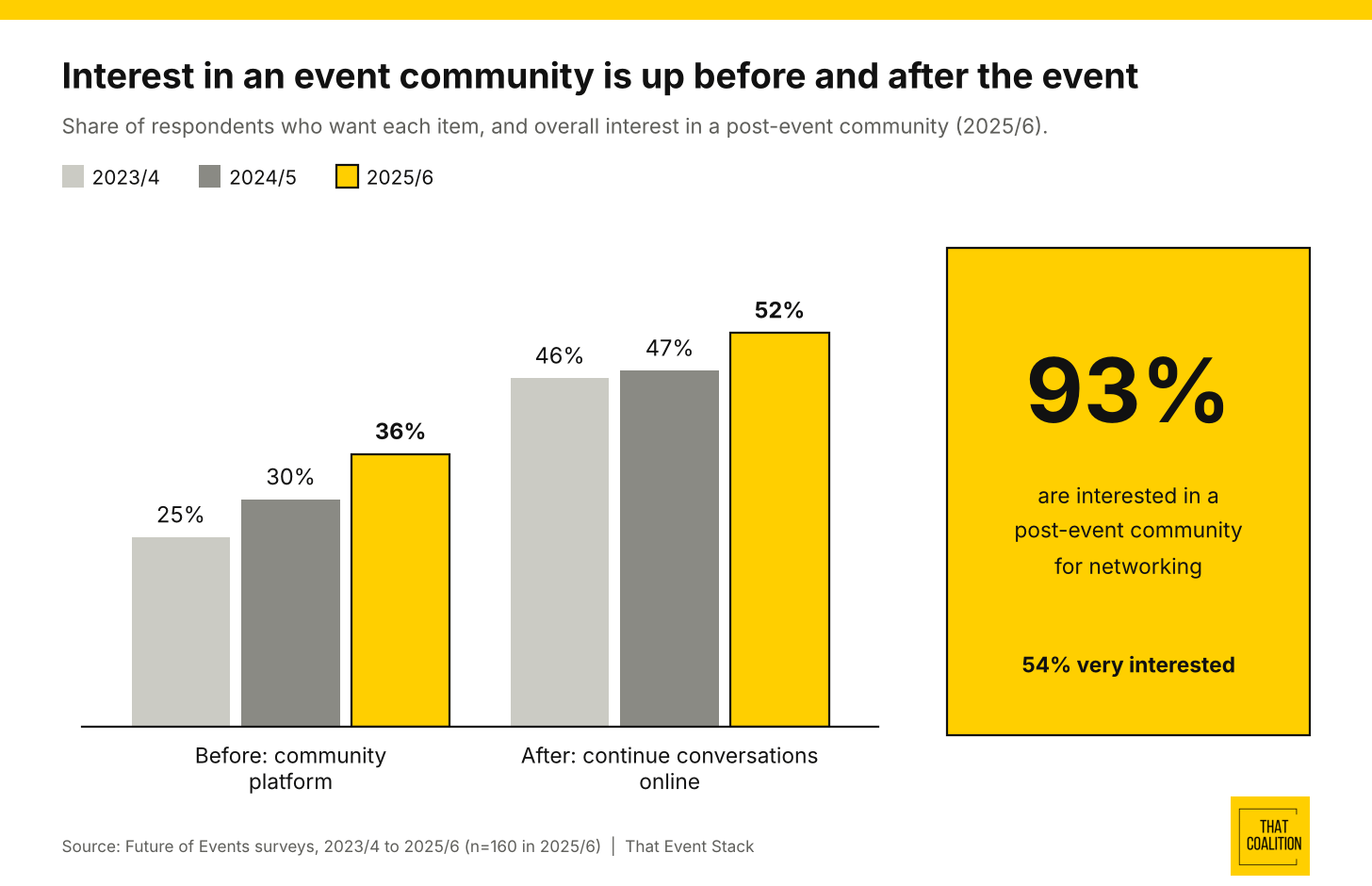
93% are interested in a post-event community for networking, and 54% are very interested. Wanting to continue conversations online rose from 46% to 47% to 52% across the three surveys.
The demand is clear. Delivery is harder. In my experience, event communities go quiet because members have no reason to come back.
Properly designed event content creates triggers. Every session leaves behind a summary, a quotable line and a question nobody got to ask. Posted into the group, those give members something to react to. Add the themes that ran through the whole event and the community has a shared experience to converse about.
It also helps people who weren’t in the room at the time there, as I mentioned elsewhere above. A member who missed a segment on day two can catch up in ten minutes and join in the conversation.The value of shared content is also obvious for communities that include members beyond only those who were at the event.
Planning
Design your content plan. Plan your outputs while you build the programme. Decide what you want to produce across sessions, segments and and the whole event. Decide who it is for. Don’t leave this until after the event.
For your audience. Video and/or audio recordings plus write-ups of every session. Cross-session and event analyses, newsletter copy, quote cards and clips that speakers can share with their own networks.
For your sponsors. A report showing where their name, their themes and their market came up across the event. Sponsors who see evidence find it easier to justify a renewal. Branded post-event briefings are also something new to sell.
For yourselves. Which new topics emerged in the room, which questions came from the floor, what was rising from one event edition to the next. Your archive becomes a record of what your industry said, year after year.
For AI. Transcripts and summaries as a searchable record of everything said on stage, with every speaker, company and topic tagged. Give it to your own AI assistant and it answers attendee and sales questions from what was actually said at your event. Where rights allow, the same record helps the AI tools your audience already uses find and quote your event.
Do this, and it will ensure that you have content that leaves event rooms with a designated purpose.
Sources
Three Years of Data: How Attendees Are Recalibrating What Justifies Showing Up at Events, That Event Stack
Future of Events survey 2024-2026, That Coalition