

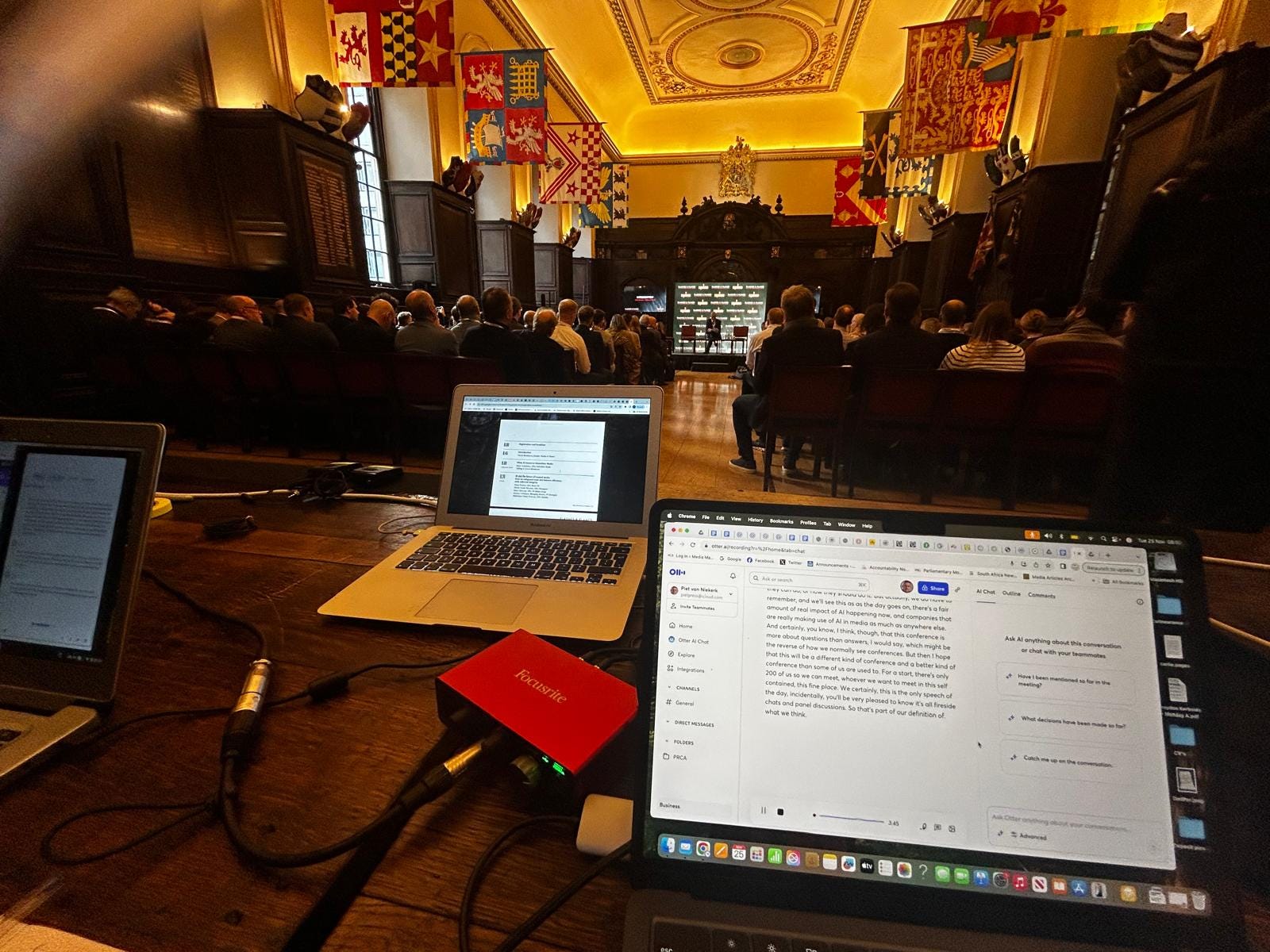
Two days ago, I found myself inside Stationers’ Hall, London - the 17th-century home of the 622-year-old Worshipful Company of Stationers and Newspaper Makers - live-reporting an AI conference using AI. If there’s a better metaphor for the moment the events industry is in, I can’t think of it.
Stationers’ Hall is where early printers and booksellers once stamped their ownership onto Shakespeare’s plays and Dickens’ novels, and where the Register became the backbone of the first copyright laws. It is a place built on the idea of protecting intellectual labour. And on Tuesday, inside that same wood-panelled hall, the conversation was about how AI is reshaping that labour: not abstractly, not someday, but now.
Staged by Colin Morrison’s Flashes & Flames and Peter Houston’s Media Voices, media and event executives gathered in the birthplace of copyright to ask a deceptively simple question: how will AI reshape every business built on content, including the events industry itself?
In the back of the hall we had our own operation running: a Focusrite Scarlett Solo (designed for musicians, repurposed by journalists who should know better) wired into a MacBook, while Otter.ai cheerfully swallowed a mixed feed from the sound desk. We tapped in speaker IDs at speed, knocked out summaries before the next chair even cleared their throat. AI not as a theory, but a tool — scruffy, speedy, occasionally chaotic, and utterly worth it.
What followed across the sessions was an unexpectedly clear narrative. The event industry isn’t dabbling in AI. It is reorganising around it. The recurring themes came quickly and repeatedly, and by the end of the afternoon it was obvious: AI won’t replace events, but it will remake the companies that run them.
Matchmaking made with AI
The first major theme was matchmaking, the long-promised, long-suffering holy grail of events. Greg Hitchen of Terrapinn framed it bluntly: AI may disrupt many industries, “but it cannot destroy face-to-face.” What it can destroy is bad matching, wasted footfall and exhibitors who leave wondering whether the right people walked by without ever stopping. Alison Jackson of Nineteen described the trade show model as simple on paper - hire a hall, sell space, fill it - but painful to execute. Sales scripts, qualification calls, hit-and-hope meeting arrangements. AI is finally starting to cut through the friction. As she put it, we’re still at “the MySpace stage,” but the direction of travel is unmistakable.
RX’s CIO, Robin Tapp, showed what happens when that direction becomes operational. They’re already capturing not just who met whom, but whether those meetings were good, and why. Combine that with QR engagement, sentiment scoring, and a recommendation engine that tells you “if you liked this, go there next,” and live events suddenly behave like high-functioning digital platforms. The point isn’t to replace serendipity but to engineer more of it. By the time RX stages the New York edition of a sector event, they already know what trends dominated London and Paris.
Then came Informa. And if the earlier examples were promising, this was industrial-strength execution. Strategy Director Alex Roth talked about a future where exhibitors no longer buy floor space but buy lead intelligence, and the right to exhibit flows from that relationship. Their churn on these insight products is literally zero. They’re folding app behaviour, beacon data, facial-reaction analysis and licence-protected content into a single decision-making engine. When Roth says their moat is deepening, that’s not rhetoric; that’s architecture. He even suggested a future where the physical booth is almost the wrapper — the data is the product.
Data on steroids
Which led naturally into the second major theme: data. Not data as exhaust, not data as a spreadsheet exported at the end of the show, but data as the core asset of the events business. Whether it was Emap using AI to give awards entrants personalised feedback at scale, or Nineteen testing AI-assisted sales calls, or RX mapping the commercial DNA of an entire sector, the message was identical: if the last twenty years were about digitising content, the next five will be about weaponising insight.
Festivalisation
A third recurring theme was the transformation of the event experience itself. “Festivalisation” is the current buzzword, but the underlying point is serious: younger audiences will not tolerate bad production values, boring panels and stale formats. They want inspiration, clarity, actionable outcomes and some actual joy. AI won’t generate the atmosphere, but it will help curate, personalise, direct and energise it. As Robin Booth put it, conferences have been “too complacent for too long.” AI forces a higher bar — better content, better analytics, better human experience.
The AI culture shift
Threaded through all of this was perhaps the most important theme of the day: AI isn’t a technology rollout; it’s a cultural shift. The companies getting ahead aren’t those with the best tools; they’re those encouraging their staff to experiment. Informa has hundreds of internal AI apps already built by employees through their in-house LLM “Alicia.” Mumsnet’s Sue Macmillan talked earlier about the mindset shift — AI as “an electric bike, not a driverless car.” You still steer. You still think. But you move faster.
That cultural shift also shapes how the industry thinks about risk. Whether it’s copyright, transparency, LLM crawling or data privacy, the mood was not panic but pragmatism. This room - inside a building founded to regulate the first printing presses using movable type, the 15th-century system of rearrangeable metal letters that revolutionised publishing - was talking about AI in almost the same way the Stationers once talked about that technology: a force so transformative you either embrace it and shape it, or you get flattened under someone else’s future.
Following the money
And finally, circulating beneath all the sessions was the real shift: monetisation. The industry is moving from selling presence to selling outcomes. From square metres to qualified intent. From attendance to attribution. AI makes that possible at scale. And once it is possible, it becomes expected.
Our own little experiment at the back of the room mirrored the sector’s wider transition. AI didn’t replace reporting; it replaced the admin that slows reporting down. It didn’t replace judgement; it made judgement faster. It didn’t replace the human voice; it cleared space for it.
So here we are, on Thursday, two days after the event, catching our breath and stitching together what became clear only in retrospect: the event sector is not just “AI-curious.” It is, in a way that surprised even me, AI-serious. This wasn’t an industry debating whether to adopt AI. It was an industry debating how fast they can do it.